
Venus-Inanna’s Descent and Rising
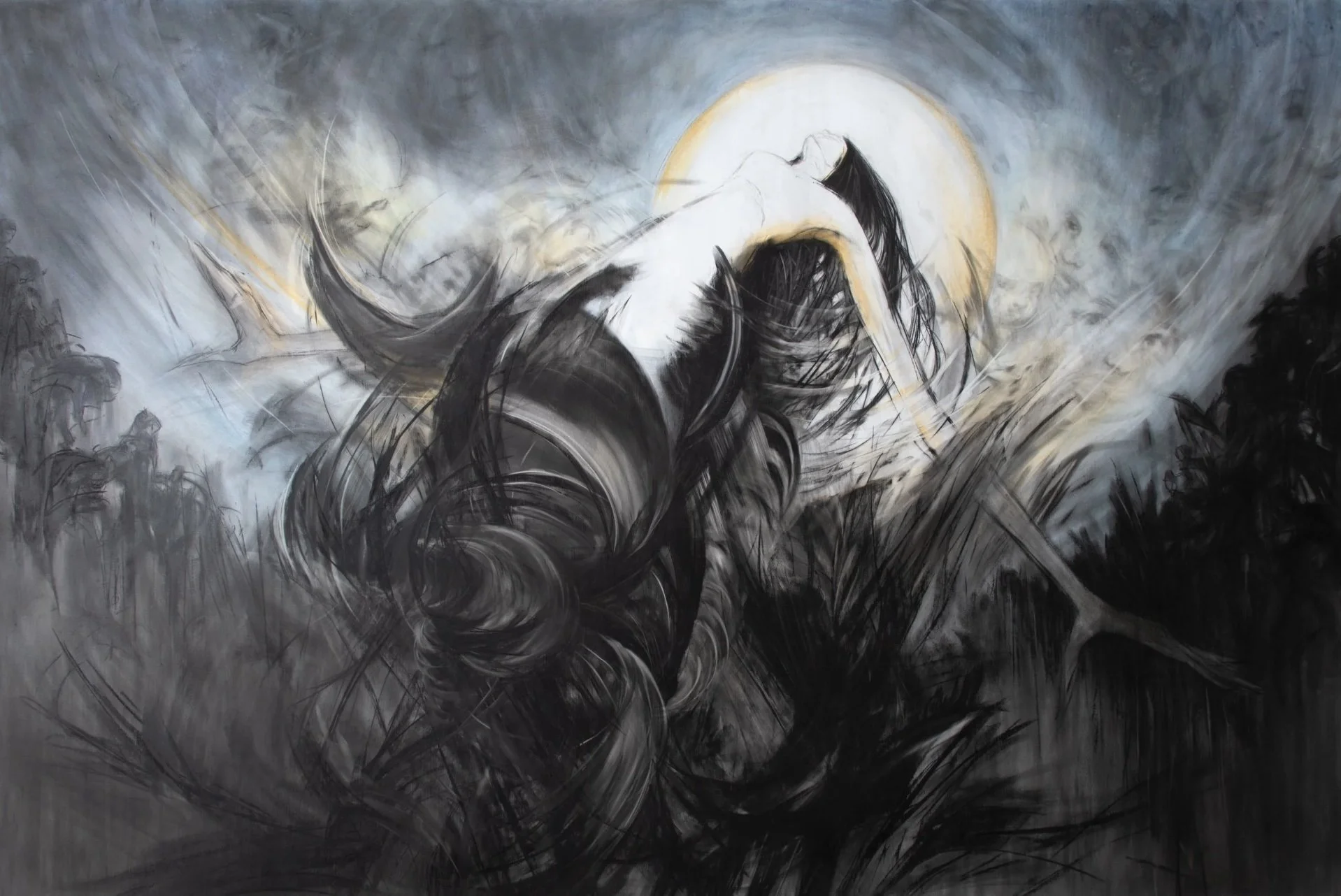
The Tale of Ereshkigal and Inanna
Hello, friends. With Venus on the cusp of her descent to the underworld (October 19) before she reappears as “Venus Lucifere,” Venus light-bringer, or Morningstar on October 29 I thought I’d share the tale of her descent and rising.
A couple of years ago, for a reading I did for a loved one, I wove together my favorite sources for the myth Inanna—the Sumerian Venus—and her GrandMother-Sister Ereshkigal.
Those sources are: 1) Diane Wolkstein and Samual Kramer’s “Inanna: Queen of Heaven and Earth;” Sylvia Brinton Perera’s “Descent to the Goddess;” Carly Mountain’s “Descent and Rising;” and the Oxford Electronic Text Corpus of Sumerian Literature. I cannot recommend these highly enough. You might go and support these authors by purchasing their work, if you feel so inclined.
Inanna’s (or Venus’s) descent into the underworld begins on the 19th of this month, when we will not be able to see her for 10 days.
I love imagining how this may have felt for our ancient ancestors. Every other luminary that dies and is reborn does so in three days; the Moon spends three days in her dark phase before the crescent light is reborn. And the Sun sits at her lowest point in the sky for three days before beginning to rise again around Winter Solstice.
Not so with Venus-Inanna.
I imagine our ancestors seeing her queenly descent, her disappearance, and expecting her to reappear three days later too….only….she doesn’t.
And I imagine the relief they may have felt when she reappeared on the opposite side of the sky, 10 days later. For us, this month, when she reappears around the 29th of October, she will do so as the Morningstar, the bringer of the light of dawn. I talk about that more in depth in my way-too-viral-for-my-comfort video, “No Way…They Called Her WHAT?” (And, if you visit there, an invitation to recall that none of this is literal, theological, or even metahpyshical for me. It’s the symbolism of psyche and life that feels most compelling to me.)
The myth of Inanna and Ereshkigal, to my understanding, may be the oldest written myth we have; it is thousands of years old. I make no claims regarding historical primacy. Rather, this is a weaving of four sources that I love; one that feels authentic to my own imaginings. I hope you enjoy it. You are very invited to stay for the tale.
Maybe make a tea or a coffee or a cocoa for yourself, and light a candle for the evening star about to descend into the underworld.
Here we cross the threshold out of Kronos time, into Kairos time; the mythic; the timeless, as I share the tale of Ereshkigal and Inanna, these ancient figures of the feminine in us all who both are and are not each other:
Before she was Ereshkigal, she was Ninlil; she who ruled the heavens alongside Enlil; she whose womb poured grain in abundant life; whose existence ruled the mysteries of the Life/Death/Life cycle. Ninlil—who becomes Ereshkigal—began her days as this sacred mystery, whole in Herself; the mystery of how seed, dying, transforms into living flower; waxes into maturity; blooms; then wanes in return to the soil, now become more seeds; held in earth herself; only to be reborn. Life/Death/Life.
For there is no Life-Death in myth. In these storied realms, there is only Life/Death/Life. As in the stories, so in us.
Little wonder she is mother of the Moon.
Her story teaches us how our souls came to fear death as an end, rather than trusting the mystery of death and rebirth; how we came to enshrine the violent pseudo-masculine, and fear the cyclic feminine.
You see, Ninlil’s husband, Enlil, was brutal; and repeatedly attacked her. In retribution, the gods cast him into the underworld. Out of these attacks, she birthed her son, the Moon, whom she called Nanna. Even in the face of terrible violence, Ninlil created life.
Nanna, her son, later becomes the father of I-nanna, that bright light in the sky we know as Venus. So Ninlil-Ereshkigal is the grand-mother — the Great Mother — of Inanna; the creative matrix from whom Inanna, our bridge to our innate, embodied values and Queen of Heaven and Earth, descends.
Ninlil-Ereshkigal, out of a tragic, entwined sense of loyalty to her husband, descended to the underworld to save him. And he, in another betrayal, trapped her in the underworld to take his place, allowing him to return to the upperworld, where he eventually became King of the Sky Gods.
To Sylvia Brinton Perera, one of our great guides, Ereshkigal’s entrapment in the underworld symbolizes raw instinctuality, split off from consciousness; that she is the “root of all…the place where potential life lies motionless…energy banishing itself into the underworld, too awesome to behold, like primal childhood experiences and the darkness of the moon, places of oblivion that are the perilous ground on which daylight consciousness treads, the primal matrix.”
So when we consider that we too may have an inner Enlil, the Sky Father, capable of betraying our inner Ereshkigal, the Great Mother, we might consider that we, too, may be carrying that split.
Inanna, Queen of the place where the Sun rises, Inanna of the east, gets word of the death of Gulganna, another husband of Ereshkigal—the shadow of Enlil—and feels called to be with Ereshkigal, to honor the funerary rites of her shadow husband.
This is no small thing. Inanna, the myth tells us three times, gives up the heavens, gives up the earth, and descends; gives up the heavens, gives up the earth, and descends; gives up the heavens, gives up the earth, and descends.
But before banging on the door to the underworld and demanding entrance, she prepares her dear friend and servant, Ninshubur, instructing her to keep watch; that if Inanna does not return on the 3rd day, as heavenly orbs are want to do (with the Sun at Solstice and the Moon every month), then Ninshubur is to perform a series of grieving rituals, and, Inanna tells her, she must go to the house of Enlil, her grandfather, the very sky god whose betrayal entrapped Ereshkigal in the Underworld, to ask for help.
And if that does not work, Ninshubur is to go to Father Nanna, the Moon, and ask for help.
And if that does not work, she is to go to Enki, who Sylvia Perera reminds us is “lord of the earth” …the wily water and wisdom god, ruling the flow of the seas and rivers. He lives in the deep abyss…. His waters were equated with the engendering power of semen and amniotic fluid… and is represented with a flowing water jar that suggests the constellation of the Water Bearer, Aquarius.” She continues, “But Enki is more generally equated with Capricorn, the fish goat, who can traverse the depths and heights and is the true complement of the Great Mother in her sign of Cancer. [He] is the generative, creative, playful, empathetic male…the culture bringer, not the preserver of the status quo. His wisdom is that of improvisation and empathy…Enki’s consciousness is like the second chakra, svadhisthana, where ‘trust in life and the self is the wisdom of the maternal waters.’ Trust, fluidity, ecstasy, and lubricating acceptance of what is. His waters … restore the wasteland, symbolic of the never-ending flow of life’s energies.” (DttG 67).
So it is that Inanna teaches Ninshubur what to do if she doesn’t return from the Underworld as the other gods do. Inanna then goes to the gates of the Underworld, announces herself loudly, and requests or demands entrance. In preparation for her Underworld encounter, she gathers a set of powerful upperworld objects called the “me” : her crown or Turban, lapis beads, necklaces, breastplate, gold bracelets, measuring rod and robe.
The chief doorman of the Underworld, Neti, greets her; hears her aggressive pushing and shouting to be admitted; reports it to Ereshkigal, who feels so enraged at Inanna’s bold intrusion and insistence on being with Ereshkigal in her grief that she slaps her thigh and bites her lip. Ereshkigal then orders Neti to bolt all seven gates to the Underworld shut, and to require Inanna to remove one of her upperworld objects at each of these.
At the first gate, she is told to remove her crown. Incensed, she questions Neti. After all, she is the Queen of Heaven and Earth. “What is this?” She asks. And the Gatekeeper replies, “Quiet, Inanna. The ways of the Underworld are perfect. They may not be questioned. A divine power of the Underworld has been fulfilled.”
Here, those of us who have had psyche insist on our descent may recognize something in these words. There is no bargaining with the ways of the Underworld.
Our Crowns must be removed. Carly Mountain suggests that this might represent, “The way we think we are seen by others (whether imagined or real) and the way we want to be seen.” She suggests that, “We might be fooled into thinking… ‘if I just do this, if I am just good enough, important enough,” maybe I can be sidestep suffering.
But, for the descent to bring healing, we have to compost what we were; we have to compost our crowns to give mulch to and nourish our roots. And so, Inanna removes her crown.
At the second gate, Inanna is told she must remove the small lapis beads from her neck to continue the descent.
“What is this?” She asks again, indignant. And the Gatekeeper again replies, at Ereshkigal’s command, “Quiet, Inanna. The ways of the Underworld are perfect. They may not be questioned. A divine power of the Underworld has been fulfilled.”
Carly Mountain suggests that, when we remove our lapis beads in the descent, we enter “a sense of spiritual and cultural homelessness where we discover what is holding us beneath human structures and expectations.”
At the third gate, Inanna is told she must remove her double strand of beads, the twin egg-shaped beads. “What is this?” She asks again, still outraged at the temerity of this gatekeeper, perhaps not realizing he is acting according to Ereshkigal’s instructions. And the Gatekeeper again replies, “Quiet, Inanna. The ways of the Underworld are perfect. They may not be questioned. A divine power of the Underworld has been fulfilled.”
The egg is an ancient symbol of cosmic mother, the womb and matrix of life; placed on her neck, we might imagine them are connected to her voice. To the extent that we have sought the approval of the overculture in the use of our voice, we may experience much by way of loss as we are required to remove these beads. So it is that, as Carly Mountain writes, at this gate, “Inanna opens to her lost voices and gets to feel how she is estranged from them.”
At the fourth gate, Inanna is told she must remove her breastplate. “What is this?” She asks again. And the Gatekeeper again replies, “Quiet, Inanna. The ways of the Underworld are perfect. They may not be questioned. A divine power of the Underworld has been fulfilled.”
Stripped of what protects her from encountering her heart, she continues her descent. So it is that our defenses, our breastplates, need to be removed, though they can also be honored and thanked, even as we allow ourselves to feel what is actually going on beneath those defenses.
At the fifth gate, Inanna is told to remove her gold bracelets. “What is this?” She asks again. Though now, I imagine her indignant sense is softening. It is as though she needs the reminder that the ways of the Underworld are deeper and more ancient than she can know. And the Gatekeeper again replies, “Quiet, Inanna. The ways of the Underworld are perfect. They may not be questioned. A divine power of the Underworld has been fulfilled.”
Carly Mountain suggests that these gold bracelets may signify the last bit of Inanna’s upperworld wealth and power. “At this gate we uncover all the ways we have been powerless…awakening to the ways we are powerful….Inanna begins to question what strong actually means. Vulnerability is a strength…so contrary to upperworld ideals.”
At Gate Six, Inanna’s measuring rod and line are removed. “What is this?” She asks again, now as ritual. And the Gatekeeper again replies, “Quiet, Inanna. The ways of the Underworld are perfect. They may not be questioned. A divine power of the Underworld has been fulfilled.”
Here, Inanna must give up the upperworld ways by which she measured others (which is to say, by which she measured herself). To Carly Mountain, there is something of earth-initiation here.
At the 7th Gate, Inanna’s robes are removed, and she is left naked standing before the throne of Ereshkigal, her split off instinctuality, as Sylvia Perera suggests.
In myth, siblings represent two aspects of one archetype. Inanna and Ereshkigal belong to each other.
And so, Inanna faces this other half of her, Ereshkigal, who is both the Great Mother banished to the underworld, as well as, the poem tells us, Inanna’s sister.
When Ereshkigal sees Inanna, so vulnerable, so low, it is as though this vulnerability is unbearable to her. And the tale tells us that Ereshkigal “fastened on Inanna the eye of death. She spoke against [Inanna] the word of wrath. She uttered against her the cry of death. She struck her.” And so Inanna was “turned into a corpse, a piece of rotting meat, and was hung from a hook on the wall.”
And Ereshkigal, consumed by grief so visceral that it moves through her like the pangs of childbirth, collapses to the ground, anguished.
Meanwhile, in the upperworld, three days and nights pass, and Ninshubur—Inanna’s friend and servant; the witnessing capacity in the psyche—follow’s Inanna’s instructions. She dresses for ritual mourning, and grieves Inanna’s passing.
She goes to Inanna’s Grand Father, the sky-god Enlil, and asks him to help. She pleads with him not to “let your precious metal be alloyed there with the dirt of the underworld.” (You might recall that metals represent the essences of the planet gods and goddesses themselves, under our feet, embedded in earth).
Enlil answers “in his rage” with the following reply: “My daughter craved the great heaven and the great below. The divine powers of the underworld should not be craved, for whoever gets them must remain…” And in a moment of awful irony, Enlil — who, we remember, was himself supposed to be in the Underworld still, but betrayed Ereshkigal to trap her there — utters a final abandonment of his daughter, Inanna, by saying, “Who, having got to [the underworld], could then expect to come up again?”
I can’t imagine a more dramatic illustration of the hypocrisy and insecurity of the pseudo-masculine consciousness that Enlil personifies.
Undeterred, Ninshubur moves on to the moon god Nanna, son of Ereshkigal; father of I-nanna. He, too refuses to help.
But there is one father who helps. Enki, that wily, watery, wise, playful, creative, improvisatory sky-god, his fingers carrying the earthen soil in which he works his sculpting and gardening ways, comes up with a plan.
He takes some clay from under his fingernails and fashions two creatures, one kurgara, the other galatur. To galatur he gave the plant of life. To kurgara the water of life. And he told them to descend to the underworld, to pass through the entrance “like flies,” or phantoms. He told them that, when they arrived in the depths of the underworld, they would find Ereshkigal writhing on the ground as though she were in the pangs of birth; that they would recognize her because her breasts would not be full as an expectant mother, and her hair would be like leeks; and she would be calling out in agony.
And here, Enki, gives a crucial set of instructions. He tells his little creatures, his little mourners, that when they hear Ereshkigal call out, “Ah! My heart hurts.” That they are to say to Her, “You are troubled, our mistress. Your heart hurts.” And when she says, “Ah! My body hurts!” They are to say, “You are troubled, our mistress. Your body hurts.” They are to repeat this as she cries out in her grief, until she is healed of her rage and pain.
Enki then informs them that, once she has moved through her pangs of grief, she will offer them a great flowing river, which they are to refuse. Then she will offer them a great field of grain, which they are to refuse. At this point, he says, Ereshkigal will offer to give them whatever they may ask; and they are ask her to swear it, and then ask for the corpse on the meat hook. He tells them that she will say, “That corpse is your queen.” And they are to respond, “Whether our king or our queen, we know not, but we ask to be given the corpse.”
And so Enki’s creatures enter the underworld as if they are flies, as phantoms, and they arrive at the scene of Ereshkigal’s rage-filled grief and pain. She cries out, “Ah! My heart aches!” And Enki’s mourners say, “You are troubled, our mistress. Your heart aches.” And She cries out, “Ah! My body aches!” And Enki’s creatures say, “You are troubled, our mistress. Your body aches.” This they do until her pain has subsided, and she says, “Who are you? If you are gods, I will speak with you. And if you are mortals, I will grant you a destiny.”
There is something so simple about the mirroring and empathy here. To think that these strange little empathic creatures within us have the ability to mirror the rage and anguish of those parts of us that were split off from consciousness, banished to the underworld of our psyches, and that, through such empathy, the rage and hurt may be transformed; well, that fills me with wonder. And I love the recipe for offering empathy contained in this myth, in three parts:
Speak that you see the suffering. “We see that you are troubled.”
Name the person as someone who has place in your soul. In this case, they grant Ereshkigal the title “our mistress.”
Mirror the pain. “Your heart aches.”
No fixing. No working. Just holding a simple space. “I see you are hurting, my friend. Your heart aches.”
Returning to the tale, Ereshkigal offers Enki’s mourners a great flowing river, just as he said she would. They turn it down. She offers them a great field of grain. They turn that down as well. She offers whatever destiny they may ask. They invite her to swear it. She does. And they say, “We would like to take that corpse on the meat hook.”
“That corpse is your queen,” she says. “Whether it is our king or our queen, we know not. But we will take the corpse.”
So Ereshkigal grants them the corpse of Inanna. They take her down from the meat hook in the underworld. Galatura anoints her corpse with the plant of life. Kurgara anoints her corpse with the water of life.
And Inanna is reborn.
As she prepares to ascend to the upperworld, the seven judges who sit at the side of Ereshkigal’s throne say, “Where do you think you’re going? No one can simply return from the underworld unscathed. You must offer someone as substitute if you are to return to the upper world.”
Inanna does not question the ways of the underworld at this point. She is flanked by demons for her return; demons who will either take her back to the underworld, or will take her substitute.
Upon emerging into the dayworld again, they encounter Inanna’s faithful friend and servant, Ninshubur. The demons say, “We will take her in your stead.” And Inanna refuses. “She is wearing the garb of mourning, a simple filthy garment, and has been so faithful to me. She sounded the drum, and visited the houses of Enlil, Nanna, and Enki on my behalf. How can I send her in my stead? No. You will not take her.”
Here, Inanna finds her , “No.”
Next, they come across a man named Sara, who was Inanna’s singer, manicurist, and hairdresser. He, too, is dressed in the garb of mourning, grieving the passing of Inanna. The demons say, “We will take him in your stead.” And Inanna refuses. “He is wearing the garb of mourning, a simple filthy garment, and has been so faithful to me. He is my singer, manicurist, and hairdresser. How can I send him in my stead? No. You will not take him.”
Third, they come across a man named Lulal, who was a faithful friend to Inanna, at her right and at her left. The demons say, “We will take him in your stead.” And Inanna refuses. “He is wearing the garb of mourning, a simple filthy garment, and has been so faithful to me. How can I send him in my stead? No. You will not take him.”
Finally, they come across Inanna’s husband, Dumuzi, who is dressed to the nines in magnificent garb, ruling from Inanna’s throne, and shows no signs of grieving Inanna’s passing.
Inanna, shocked but no longer willing to overlook such things, “fastens on Dumuzi the eye of death. She spoke against him the word of wrath. She uttered against him the cry of death.” Just as Ereshkigal had done to her. And the demons grab Dumuzi and take him to the underworld as her substitute, though he does his best to escape.
Inanna, grief-stricken at the loss of her husband in more ways than one, knows he must undergo his own initiation, his own transformation in the cycle of rebirth, which he does; and later Inanna and Dumuzi are rejoined.
But in his state at the time of her re-emergence, he was not fit to keep her company; and could not be trusted.
And so ends the tale of Inanna’s descent to and reunion with Ereshkigal; a tale of the Sacred Feminine’s descent and reunion, loss and rebirth; one that initiates the same cycles for the not-yet-sacred Masculine, who himself needed to descend and reunite with the Great Mother before he could join her.
Our tales ends with two lines that hint at something we may have lost in this story: that Ereshkigal, herself, is the tale’s main character. Here are the lines:
“Holy Ereshkigal, sweet is your praise.”
As we gently return to our day-to-day, leaving the threshold of this most ancient tale, perhaps we’ll sip a tea or a coffee or a cocoa and say to ourselves, “I’ll light a candle for the evening star.”