
Reframing Religious Shadow: Venus’s Cycle and Gifts of the Morning Star
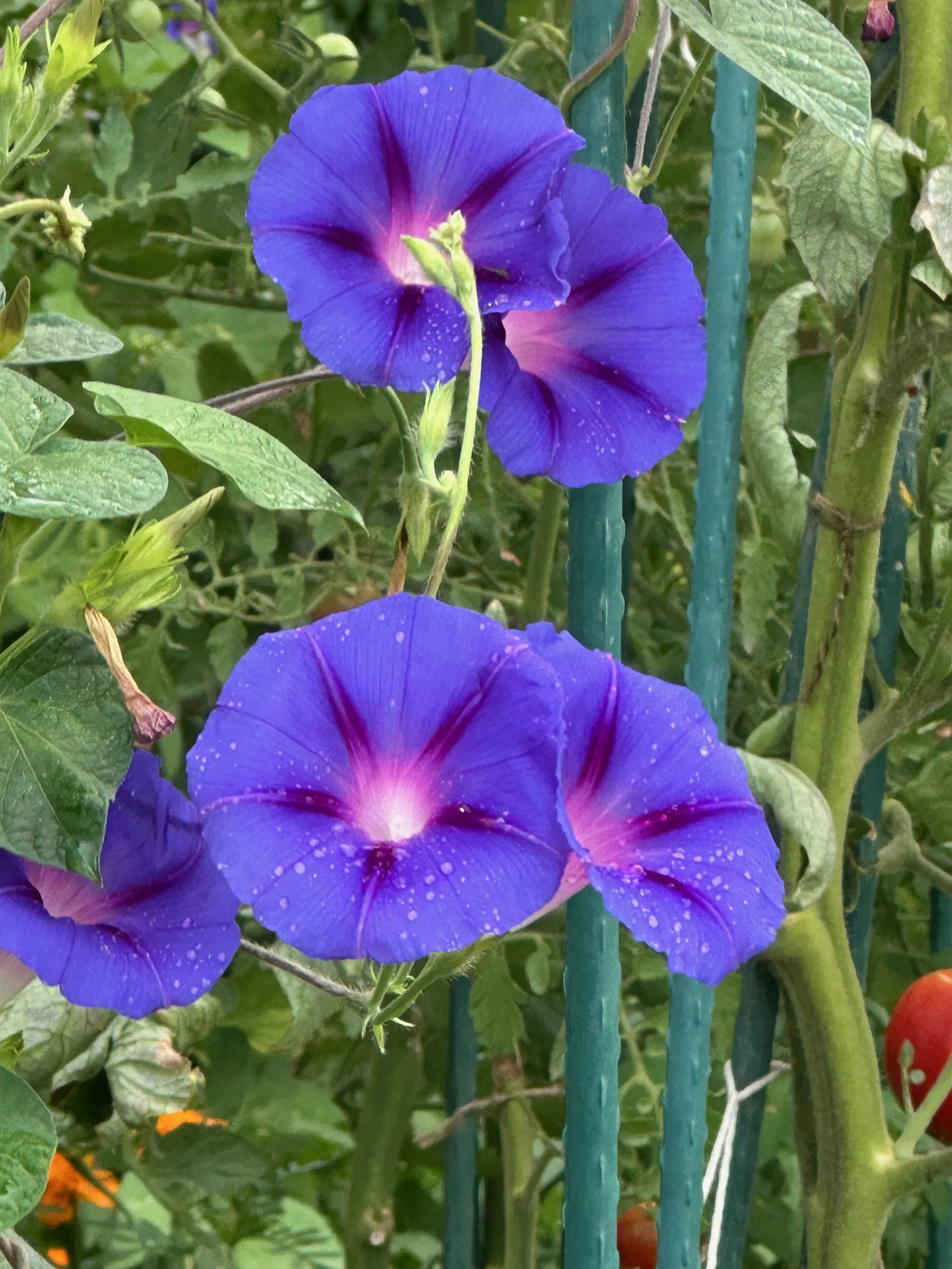
The five-pointed star of morning glories, touched by the dew, the waters of the moon.
I did not choose to exit the womb and body of my childhood faith any more than I chose being birthed into separation from my mother’s womb and body.
Rather, there were forces within and around me—much larger than my embryonic sense of self—that bore down on me, and which I experienced as simultaneously supportive, necessary, and elementally terrifying.
Navigating this passage, no literalized labels (like “deconstruction” or “stages of faith”) brought comfort, let alone a living connection to my inner life.
Rather, myth and folklore held the images that continue to support me. Allerleirauh, Vasalisa, the Red Shoes, The Warrior Who Knew How to Listen, the Goose Girl, the Moon Bear.
One of the tales that felt the most helpful turned out to be the oldest written myth we may have: the story of Inanna, her descent, death, and rebirth.
We know Inanna as Venus.
Learning about Venus’s movements in the sky transformed my understanding of some of the central myths I was taught in my religious and cultural upbringing.
It also opened a path to empathy and increased understanding towards my ancestors who sacrificed so much for the religious upbringing I was given.
For example, I did not know that Venus/Inanna alternates between being the morning star (when she shines brightly on the eastern horizon just before sunrise) and the evening star (when she shines brightly on the western horizon just after sunset).
I also did not know that, in between her being the morning and the evening star, she seems to descend into the underworld for about 10 days, twice every 584 days.
And when I first read about her title as “morning star,” a phrase from scripture that I heard often in my youth came to mind: “Even a son of the morning;” a title held by Lucifer, “that old serpent, even the devil.”
In my growing up years, rather than learning about the descent of the morning star, I learned about the fallen morning son.
In the version of the story I was taught, Lucifer (morning son) offered to force all of god’s children to be obedient, guaranteeing our return to heaven. As payment, he wanted the throne of god. For his hubris, Lucifer was condemned to fall from the light of heaven—from the dawn’s light—and be exiled into darkness.
And so the “Son of the morning” or morning son became “fallen.”
The parallels between the Venus cycles (a morning star that rises to a certain height in the eastern sky, the most brilliant star in the sky, reverses direction and seems to “fall,” and continues her descent until she enters the “underworld” for 10 days, and then reappears no longer as part of the light of dawn, but embedded in the dark of night), and the Lucifer story of my upbringing (a morning son who rises to a certain height, one of the most brilliant lights among god’s children, who then falls from his high place in rebellion and is cast out of the light of heaven, embedded in darkness as its prince) were too many for me to ignore.
My curiosity piqued.
Then, another crumb: from the perspective of earth, over the course of her eight year cycle, Venus traces a five-pointed star or flower in the sky, within the circle of the zodiac.
Let’s just say that, if you grew up where I did, especially in the 80s during the “Satanic Panic” (think Stranger Things), you did not get taught that the five-pointed star is something of geometric beauty symbolizing the order of the cosmos and connected with the 8-year cycles of the archetypal feminine.
No. The five-pointed star was the dreaded “pentagram,” Lucifer’s sign. It led to horrific things like ritual abuse, sex, drugs or, worse, Dungeons and Dragons.
So here was another connection between the Venus cycles and the Luciferian stories in my childhood: the five-pointed star.
Some time later, another startling discovery (for me): When Venus becomes the morning star, astronomers refer to her as Venus Lucifere.
Why on earth would they call her “Venus Lucifer?” I wondered.
Then, some etymological clues from a chance conversation with a philologist friend: the name Lucifer comes from the latin “Lux Ferre.” Meaning? Light (luc-) Bringer or Maker (-ferre).
So, Venus Lucifere means Venus as Light Bringer, because her light, when she is the morning star, heralds the dawn.
And, somehow, Venus as Light Bringer, She Who Heralds the Dawn, Who Descends into the Underworld and Returns, Who Understands the Mysteries of Light and Dark, Queen of Heaven, Embodied in Her Own Feeling Values, was transformed in the psyche of my ancestors into the devil himself, the source of all evil.
(This, of course, is only one of myriad instances of this transformation from divine feminine to devil; not unlike the serpent—ancient image of the goddess and her capacity for cyclical regeneration—becoming the devil in the story of Adam and Eve.)
In other words, my ancestors and I were terrified by the forces and patterns within us that we might call Venus. These include:
the principle of relatedness.
embodied knowing and visceral connection to our innate feeling values (those so deep that they exist beneath our stratified layers of socialization.)
the living breath of our aesthetic responses to Beauty.
our need to make marks and sounds in response to that Beauty, not for expression nor communication, but for relating with our own experience of life and awe.
the capacity to be held by and in the life of Mother Earth herself.
the height of Spring.
the one constellation of forces or energies within us that has the capacity to heal an isolated and severed (read: circumcised) inner Mars.
our capacity for pleasure.
our capacity for re-sourcing ourselves in nature.
a love of all things green.
And perhaps most important as the loom that brings all of these Venusian threads together:
The living experience of the balance represented by Fall Equinox—not as a static, fragile weighing of opposites that is easily disrupted, but as a living, dynamic equilibrium of movement and flow; the middle realms of soul together with the relational field woven when two or more people encounter each other within this living middle place.
Here, the principle of relatedness becomes a tangible, living field, which a friend described to me once as feeling like she might be able to touch the relatedness itself. (Thanks, Jelena.)
Now, in case anyone is reading my words literally, I just want to say again that I personally feel no theological or metaphysical interest in these ideas and experiences.
I’ve yet to encounter parts of myself (and rarely encounter others) that are capable, in our present culture, of leaving the barnacles of literalism behind as we embark on the waters of theology and metaphysics.
For me, it is the psychological, the symbolic, that draws me out (and in).
My interest in Venus or Lucifer as theological or metaphysical objects is zero.
But I feel a profound interest in Venus as a living image of those animated energies within us that are so crucial to our well-being and the vibrancy of our inner ecosystem that James Hillman once said, “Venus is our recourse.”
Or to quote another dear friend who works with those who have been deemed to be beyond help, “Aesthetics are a matter of life and death.” (Thanks, Gillian.)
We might translate her insight into astrology-speak by saying, “Venus—and all that she represents as living patterns within the human psyche and in the more-than-human world—is a matter of life and death.”
And I feel an equally profound interest in cultivating empathy towards the kind of wounding that I inherited, wounding that might lead us to view and/or experience these Venusian parts of ourselves and of the natural world as if they, themselves, were Lucifer-not-as-light-bringer, but Lucifer-as-devil.
Regardless of whether it’s intentional or not, the way I see it, the only way we could possibly find ourselves in the cultural collapse all around us is by being severed from Venus and all that she represents.
There seems to be a deep knowing in us, as a collective, that the only way to uphold the illusion of scarcity endemic to a culture of power-over is to demonize the Venusian in us.
No Venus, no connection to our own living matter, our own earths, our bodies.
Once we’re convinced that our bodies are nothing more than husks to be discarded—rather than the profound sources of living wisdom that they actually are—it only takes one step to feel the same way about the living land, our “Mama Earth” (thanks Vive and Kathleen), and Her incomparably creative body.
As it happens, this year, Venus was at her brightest as the evening star precisely on the Fall Equinox in the Northern Hemisphere. In her cycle, that means she is about to descend to the underworld for 10 days; just as we begin our descent towards winter solstice up north.
Her light, shining her brightest in the darkness before her trusting descent, is an image I am currently drawing on for trust and support. When I light a candle, I see her star in the night sky in my imaginal eye.
And as we see her descend from sight in these coming weeks, we might fear, as Inanna’s dear friend Ninshubur does in the myth, that something is wrong; that Inanna-Venus won’t return from the depths.
I feel whole realms in me resisting the initiatory descents unfolding everywhere around us. I can almost hear the guardians at the gates to the underworld as I do.
In the myth, each time Inanna-Venus protests her initiations, the guardian says, “Hush, Inanna. The ways of the underworld are perfect. They may not be questioned.”
Two unlikely creatures in the tale—Kurgara and Galatura—offer empathy to Ereshkigal, Queen of the Underworld, and so catalyze Inanna-Venus’s rebirth. Our path to rebirth, too, may well stem from empathy’s gifts appearing in unexpected and creaturely forms.
I find myself wondering if, perhaps, I may be starting to understand the words of Robert Frost. I first learned them while singing in my high school choir in rural southeast Idaho: “Choose something like a star.”
“Maybe that’s what I’m doing,” I wonder, as I hold my breath, hoping and trusting that Venus will appear again after her descent in the not too distant future.
Maybe I’m choosing something like Venus as I sit in this not-knowing swirling within and around me.
Maybe I’m waiting for all she represents to usher in the light of dawn, re-birthed from the depths as the Morning Star.
And wondering how I can invite and receive that same rebirth within myself.