
Beyond the End: Our Defenses and the Myths that Hold Us
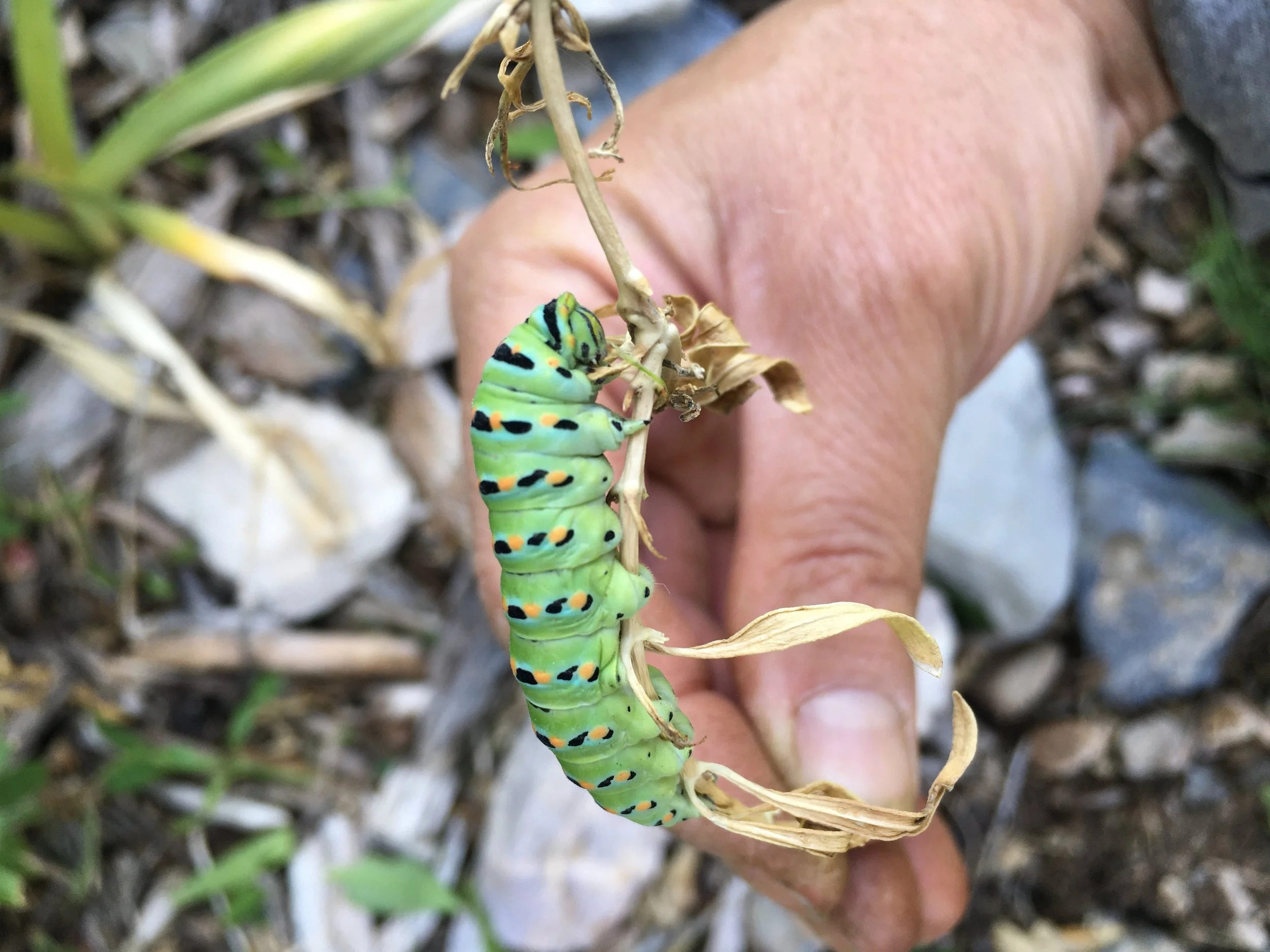
A clinging caterpillar. Does she hold the branch? Does the branch hold her? Does she know the great hand is there?
I returned today to a much loved book on wounding and the soul, and I noticed something unusual (for me)….I had skipped reading the Introduction.
(I know this because my favorite activity in the world is to highlight books as I read them, and there were no highlights in the Intro. It would be cool if I were exaggerating. Sadly or delightfully, depending on your view, highlighting really is a favorite thing of mine. :)
I don’t skip introductions. I love them. So this struck me as a bit odd.
I started re-reading the introduction, which began with a tale of the author hearing a tragic story on the news. And I knew why I hadn’t read it. That would have been enough to stop me, right there.
I’m sooooo tired of “bad news” stories.
For so many years now, I’ve had to be so careful about what stories I let into my mind and psyche.
My sense is that I am— we are (most of us? All of us?)—in the grips of a particular myth. And being in the grips of this myth, every story I hear lands as if to confirm it.
But before I share which one….
This is something that I love about archetypal psychology and depth psychology: this sense that myths are alive, that they can grip us.
They can enchant, whelm (yes, whelm…why not?), erupt, or engulf the psyche; becoming a lens or bridge by which we perceive and experience ourselves, our lives, and our worlds.
The cool thing is, once you become conscious of the myth pervading your soul’s eye, you gain something of relational capacity with it.
And once you can relate to it, on the level of soul, something new emerges; you are a touch less compelled by it, less identified with it. More aware of it.
In lieu of compulsion or identification, you relate with it; this way of seeing the world that colors everything in our experience.
Jung’s famous dictum comes to mind: that whatever remains unconscious will meet us in the outer world “and you will call it fate.”
I like to restate this in a positive form.
“Whatever you become conscious of you will be able to relate with; and it will soften its compulsory sway in your life.”
Through relationship, it will no longer feel like fate, and you will discover your capacity to act, however that may be. (Almost certainly, it will be in previously unimagined ways.)
This can be a beautiful and even life-saving experience.
We all know what it’s like to find ourselves doing shit we don’t feel “in control” of. And, for me, seeing from an archetypal lens is one way to transform that feeling of compulsion that can feel so damn scary.
Which brings us back to the myth that was holding me when I tried to read that introduction, and couldn’t because it spoke of a scary story in the news. This myth is still so often holding me:
The myth I see everywhere alive within and without is Apocalypse. The end of the world.
Every story I hear seems to be filtered, in my own psyche, through an apocalypse narrative.
Political corruption? It’s the end of democracy. Religious abuse? It’s the end of institutions. Is it raining? Snowing? Hot? Cold? It’s the end of the world.
Crucially — and I do mean crucially, as in the crux or cross of the matter — recognizing that we are being swayed or swallowed by a myth DOES NOT MEAN THAT THE PERCEPTION IS ENTIRELY OFF.
As Liz Greene says, just because we recognize something as a projection, DOESN’T MEAN IT ISN’T ALSO “OUT THERE.”
(This is an urgently important distinction for those of us who have found the strength to leave abusive situations, be they institutional or personal. It’s important to know that those who would keep us in the abusive relationship can use “projection” as a concept to gaslight the shit out of us. HBO’s “The Vow” is a masterclass in that.)
However, recognizing the soulful lenses — the myths — by which we experience our lives does allow a touch of space around our experience. It can reduce the intensity with which we believe our experience to be a wholly accurate view of reality.
Apocalypse, to me, is the collective version of this myth.
One personal version of Apocalypse can show up as a myth or fantasies of death by su**ide.
Speaking from experience, when those fantasies take hold on a personal level, they can feel intrusive; frightening; terrifying really.
Like you don’t really have control of your own thoughts anymore.
Understood literally, this myth of apocalypse can do untold damage. Meaning: if we literalize the myth of apocalypse on the collective or personal level, we might act in ways that bring tremendous suffering to ourselves and others.
By contrast, if we can understand these energies mythically/archetypally/symbolically, they can bring us face to face with the wisdom personified for ages in the image of the dark goddess, the embodiment of those forces that know that rebirth requires loss.
We might think of Kali (a trauma-informed teacher of mine summarized Kali’s archetypal energy as “This will be done. This must be done.”)
Or in Russian folklore, the Baba Yaga, who has a fence of spears topped with skulls around her home, and one of them has room for a skull shaped just like yours.
As Marion Woodman says, try to navigate the Baba Yaga encounter with rational thought, and your head is sure to end up there. Only the non-rational (which is to say the embodied and intuitive) has currency here.
We might include here images of Black Madonnas — that embodied divine feminine that erupted into the Western collective psyche in the 12th-13th centuries.
Or in Greco-Roman symbolism, characters like Persephone-Matured (as Queen of the Underworld; Proserpina; Serpent-Goddess of Regeneration), or Hekate (Dark Phase of the Moon who rules crossroads, death, and rebirth) come to mind.
In other words, to understand these myths symbolically might mean accepting that, just as the fantasies of apocalypse suggest, something needs to pass away; that something within us—individually or collectively—is no longer serving us; that we may need to let go of something we feel attached to.
It’s like the Tower card in tarot….something has been built within and without for the sake of security. But it may have inadvertently removed us, upwards, away from contact with the living earth.
We don’t build defenses intentionally. They get erected on their own, and for good reasons at that. There’s wisdom in trusting that our defenses are protecting something of value to us. Trying to get rid of them, prematurely, can actually do us harm.
But when the time is right (kairos time) along comes a Uranian or Jupiterian lightning bolt more than happy to bring down whatever it has to in order to return us to living matter; our feet on the ground.
It doesn’t matter how big the tower was that we had built for ourselves. What matters is, once Life-with-a-capital-L has brought it down, our contact with earth is no longer mediated by the tower’s many floors.
We are invited, once again, to risk letting the land herself hold us.
Astrologically, there are a few places we might explore where these defenses may have inadvertently been erected.
Of course, we can always look to Saturn and Chiron to get curious about this. Liz Greene’s Boundaries and Barriers is a stunning exploration of that.
One client of mine had Mars standing at the cusp of their 8th house (house of death, rebirth, transformation and initiation into the soul’s depths).
It was as if Mars was there to make sure 1) That they did not enter their descent prematurely and 2) That when they finally did enter, that Mars-archetype would be there to support them, to actually “have their back” (assuming they had a conscious and living relationship with their inner Mars, which many of us don’t, because being “angry” or assertive meant being bad, culturally speaking.)
Sometimes the earth-related houses (2nd, 6th, and 10th) are fascinating sites to excavate for defenses, for our inner Tower cards.
It’s possible for the 2nd house to be petrified in its love of fixed earth; and rather than resourcing ourselves there, we build rigid towers that give us the illusion of stability.
Or perhaps, in the 6th house, something of psycho-somatic illness finds its way through as both a defense and a communication from the depths, in an attempt to integrate some lost parts of ourselves.
Or, in my experience, many (if not most) of us ascend through the houses (4th through 10th), coming into an expression of ourselves in the outer world (10th) that is NOT rooted (4th house) in our authenticity; but is rooted, instead, in expectations from others.
Most of us then have to descend back down to our roots (4th) and sort out what really was ours, and what was part of a hopefully-well-intentioned-soup of familial and collective culture. (The clues of Your Very Own Myth regarding that experience are what we explore together in the Inanna’s Descent reading.)
Of course, defenses can arise in any sphere of our life….
Those with Cancer Moons in the 9th house might find the moon’s permeability to be both a blessing and a curse in their religious upbringing….Or a 12th house Chiron feels like a block between us and our ancestors for decades, until the healing offered there holds the chance at connecting us with those incredible resources.
Either way, because our experience of those defenses feels SO personal, and so essential, it can be intense to feel them passing away as we are moved towards our next cocooning.
And so the myths of Apocalypse — on the personal or collective level or both — seem to grip us.
Something has to go. Old structures must pass away.
But please remember, my dear, dear friends….
That something is not, and is never, you. No matter how much it may feel that way. You have a place here. You have a purpose here.
I have on my wall the words of a dear friend who said to me once, “You have been called to the depths, as it were. May you never return.”
And as corny as it may sound, if you’re here reading this…. Likely… you have been called to the depths too.
Something to con-sider (con-: with; -sider: the stars).
Happy exploring!
Ryan