
Mary Magdalene and the Soul’s Wandering
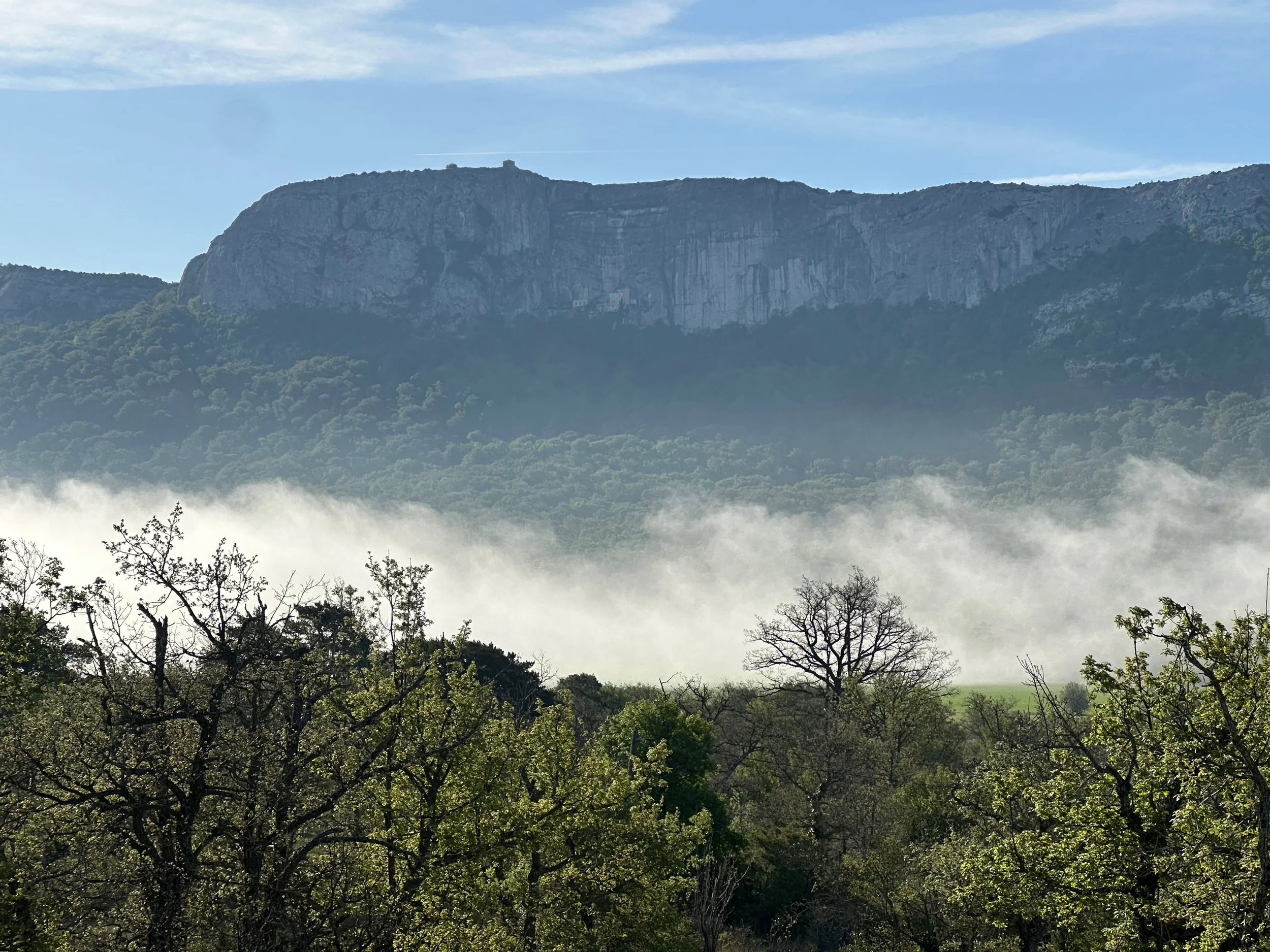
The forest, mountain, and grotto (in the distance) of Mary Magdalene in Sainte-Baume, France.
This year, my wife Holly and I went France for the first time. On the recommendation of a new and dear friend (thank you, Christine!), we visited the sacred grotto of Mary Magdalene in the ancient forest and mountains of Sainte-Baume.
Cave’s have, since Paleolithic times, been symbols of the feminine; womb-tombs holding the mysteries of death and rebirth.
Mary Magdalene’s has long been a pilgrimage site for people seeking connection with the sacred feminine. Like so many spaces connected with her, the sacred grotto is also a place for holding the loss of babies and infants, where earth herself and Mary Magdalene support those carrying such grief. It is hallowed ground.
Before the archetypal feminine energies of this forest donned the image of Mary Magdalene, they were alive in the image of Artemis, hellenistic lunar goddess, virgin complete in herself. And before Artemis, the Anatolian Cybele, great Mother Goddess. Regional lore suggests this forest and cave have been a sacred site for humans dating back to Paleolithic times.
It felt so alive to both Holly and I. We crossed the threshold from everyday time into mythic time—a threshold marked by a living spring and an ancient hollow tree—and began our journey up the mountain.
Feeling into the mountain herself, and following our intuition, we would from time to time wander a little ways from the path, and find ourselves standing in places that felt sacred to us.
As we all know, the soul moves by wandering.
We started to notice something. Often, when drawn towards a space with a living pulse that we experienced as the sacred feminine, about 20 meters away there would be a statue or shrine placed by the institutional church or the freemasons that centered masculine imagery. These markers of the institutional pseudo-masculine were near, but never in conjunction with, several of the places that felt most alive to us.
The natural effect of these markers? People walking the path would stop at the institutional shrines, but miss the beauty of the nearby living feminine energies.
It was as if the pseudo-masculine in the psyche were saying, “Pay no attention to the places beyond this marker, which is here to remind you what’s actually sacred about this space. No need to go any further. Nothing to see there.”
My body registered an energy of penitence in those who stopped at the markers. Of course, since 591 CE, the narrative accompanying Mary Magdalene has been one of allowing the feminine proximity to power if—and only if—she is sufficiently penitent. So it wasn’t a surprise to see that same narrative enacted here on her mountain, and in her forest.
It became so predictable that Holly and I started to say to each other, “Ah! Another institutional marker! Let’s explore behind there.” And without fail, we would feel into another living place on this sacred mountain.
My personal favorite? Just outside the threshold to Mary Magdalene’s sacred grotto was a sign in French: “Caution: Falling Rocks.”
But in French the word for “rocks” is “pierres.” As in “Peters.” So a playful translation might be, “Beware of falling Peters.” Just outside Mary Magdalene’s sacred cave.
I loved the honesty of that warning. “If you cross this threshold into the space of your inner Mary Magdalene, your inner Peters may just start falling.”
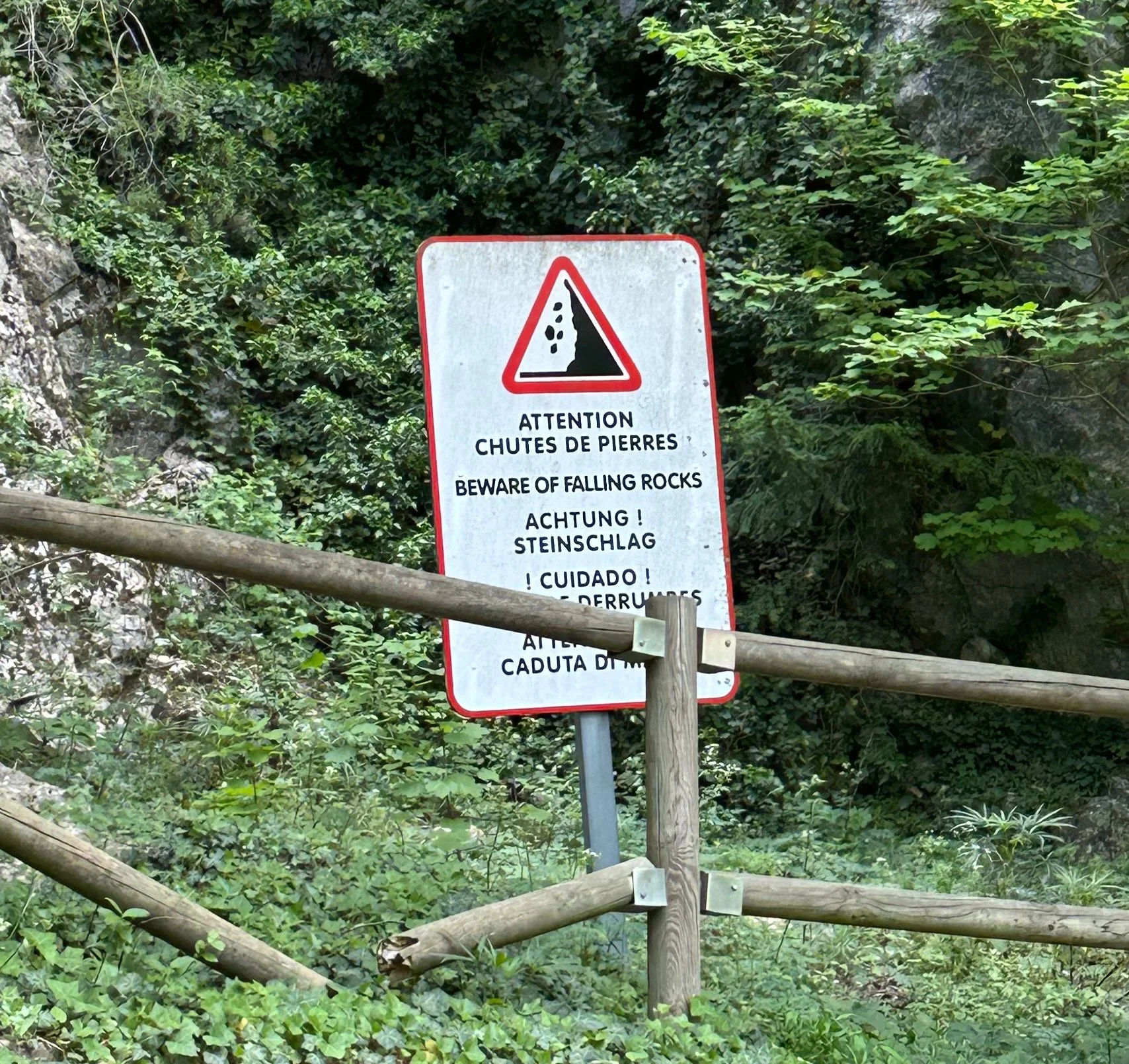
At the threshold to the Sacred Grotto: “Chutes de pierres!” Falling pierres (rocks, “Peters”).
We had fun imagining a bit of subversion on the loose, alive in those who placed this sign.
But that imagery won’t leave me: pseudo-masculine markers (unintentionally?) occupying places in ways that prevented people from entering the field or pulse of the sacred feminine.
It is as though, when there is something of the feminine—of newness, of gestating creative life—alive in the land, then some part of us feels it crucial to distract from or occupy it.
From a place of empathy, I can understand that impulse to distract from the living within. It can hurt to feel into our disconnect from her. I would say that I distract from those living places inside of me, on some level, almost daily.
The pseudo-masculine within, attached as it is to power-over and a fantasy of moving towards “perfection,” cannot trust the feminine capacity for newness, the ways that mother Earth lives and breathes.
“To move towards perfection is to move out of life,” Marion Woodman writes.“Or never to enter.”
So I’ve been wondering, where have I erected shrines to the pseudo-masculine in my own psyche, in the “territory of myself” (to quote Thich Nhat Hanh)? What are the markers that keep me from encountering the living feminine within and without by saying, “Wait right here! You need to remember your brokenness for a moment. And also, pay no attention to the swirling vortex of living energy just over there….”
Where are the “places” within me that, when I get near them, a little voice comes on that is worried about status, or the perception of others, or my own “worthiness,” or my place in the village? Where those are, I’m probably getting close to something alive, just beyond those worries.
How often do I accept a pseudo-masculine substitute for the sacred, rather than trusting my soul’s hunger and the wandering path?
Liz Greene calls it the “circuitous meanderings” of soul. I love that.
It’s not hard to see this same phenomenon in astrology.
Aries, the glyph so clearly related to the sacred M of the goddess, to the chevron, related to the birth of spring, becomes a Ram, a go-getter, a doer! Striving! Competing! Ruled by Mars, that ancient archetype within that was once the God of New Beginnings. Now? God of War. “Nothing to see here. Move along. If you have placements in Aries you’re probably competitive and hot-headed. Pay no attention to the sacred feminine so clearly present in the imagery here.”
Maybe we have conspired with these markers in ourselves, placed by our own pseudo-masculine impulses, hoping they would lead us up, up, and ever more up.
Towards perfection. Which is to say, out of life.
As for us?
Well…. We kinda loved the living spaces….