
Pop Astrology and Patriarchal Seeing: Reclaiming the Archetypes of Your Life
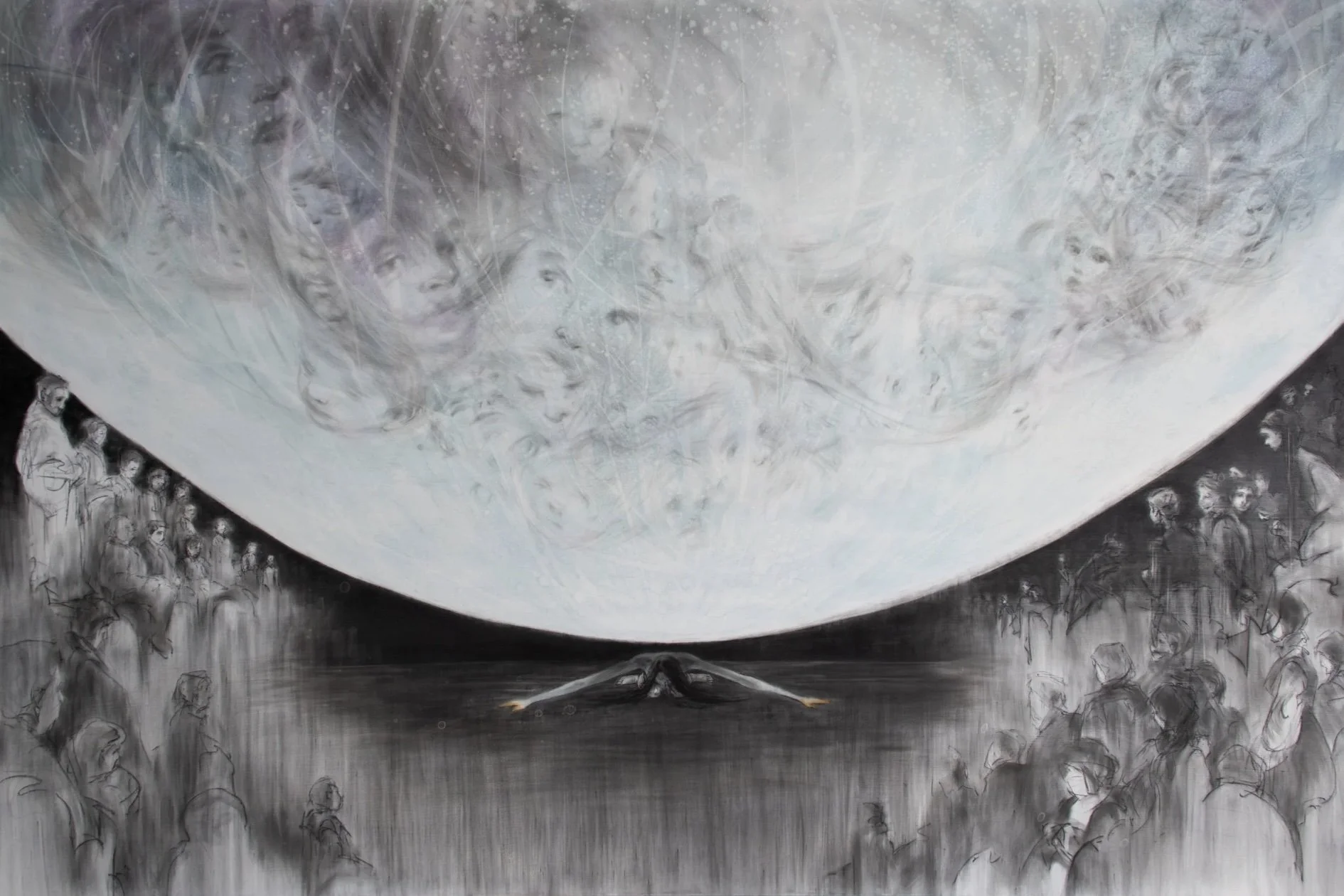
“Barred Mother” by Holly Parson Nielsen
When I started learning astrology from popular sources, I was also studying the works of Marion Woodman, depth psychologist and teacher of the sacred feminine. Woodman, in ways that felt helpful to me, did tremendous work in understanding the nature of patriarchy.
For starters, she gave patriarchy an alternative name that is, to me, far more accurate: pseudo-masculinity.
To Woodman, patriarchy is not the inevitable outgrowth of masculinity. It is a counterfeit for the psychological energies and life energies we call “the masculine.” It is pseudo. False. Like a pseudo-nym, a fake name. Pseudo meaning deceptive, in appearance only.
To her, the pseudo-masculine is driven to consume matter (mater, mother) because of the neglect of the feminine within us all. Because we have lost touch with our soul’s actual hunger, our appetites cannot be satisfied. And so we continue to consume matter, as if it were dead, even as our souls yearn for a relationship to matter (mater, mother) that is ensouled.
And she defines the pseudo-masculine soooo beautifully: a culture, based on power, that pursues perfection. “Perfection massacres the Feminine,” she reminds us. “It is easier to try to be better than you are, than to be who you are.”
This, to my perception, has everything to do with how we interpret the language of astrology.
What if popular conceptions of the signs and planets are not descriptions of how those archetypes must show up in the world?
What if pop astrology describes how those energies show up when occupied by the forces of the pseudo-masculine? By a culture of power-over?
Let’s talk Leo. Often Leo is presented as “the Performer,” attention seeking, extroverted, performative energy that wants to be in the spotlight all the time, and is prone to leadership for that reason.
Leo, many books suggest, needs external validation regularly. Like, all the time.
This just didn’t line up with my own felt-sense of those Leo energies, in my own life and in the lives of those whose charts I was studying.
So I found myself asking, what if that isn’t an accurate perception of Leo? Not that this popular sense of Leo is entirely without cause. From time to time, it might even be accurate on some level in someone’s life.
But when I zoomed out to look at the influence of a pseudo-masculine overculture, I found myself asking:
What if the popular versions of Leo aren’t an accurate painting of how the archetype of Leo shows up?
What if the popular rendering of Leo is, instead, how Leo shows up when occupied by the forces of the pseudo-masculine? When occupied by a culture of power, pursuing perfection?
This question unlocked something for me: Leo as the innate need to radiate a sense of uniqueness; to give creative voice to that sense of uniqueness, in relationship. Leo as the profound human need to be witnessed, mirrored, to be seen. Not as performative, but as containing and affirming.
Want to see Leo in action? The next time you are at a store and you hear a small child cry, catch their eye, and mirror their sadness to them, if only for a moment. Let them know they are seen. And then watch things transform.
Same archetype. Different conditions.
Two more examples. Take Virgo. Many of the astrology books I read spoke of Virgo as a force that drives near obsessive (or totally obsessive) organizing and cleaning perfectionist impulses.
In a (funny?) irony, they were obsessively obsessing about Virgo’s (potentially) obsessive qualities. It was tough to find versions of Virgo that weren’t connected to words like, “controlling.” And perhaps that is how some with prominent Virgo energy experience this archetype of the Virgin.
But it wasn’t supportive to anyone whose chart I read with prominent Virgo themes. They might feel validated, but they’d also feel trapped.
So, let’s ask our question again. What if that isn’t a snapshot of Virgo? What if it is a snapshot of how Virgo shows up when occupied by the forces of the pseudo-masculine? Virgo occupied by a culture of power-over?
By contrast, Virgo, planted in the nourishing soil of the archetypal Feminine, becomes the light of the full moon, the Virgin as Feminine-complete-in-herself.
We might say that the archetype of Virgo has the capacity to provide, for herself, the very witnessing Leo so deeply needs, and to become, herself, a fully self-sustaining ecosystem of soul.
What if the perfectionism so often associated with Virgo is what Virgo does when she is struggling to find a voice—or even oxygen—in a pseudo-masculine culture?
Same archetype. Different conditions.
One last example: Mars. We read and hear of Mars as aggression, competition, assertion, and war-like tendencies. Mars-as-god-of-war.
But let’s ask our question one more time. What if that isn’t a snapshot of Mars? What if that is a snapshot of how Mars behaves when occupied by the forces of the pseudo-masculine? Mars occupied by a culture of power-over? Mars without the aesthetic aliveness of Venus?
James Hillman points out that, before Mars was the god of war, he was the god of New Beginnings. That’s really different from aggression, war, and violence.
Mars-as-the-miracle-of-sprouting.
Same archetype. Different conditions.
Happy exploring!
Ryan